
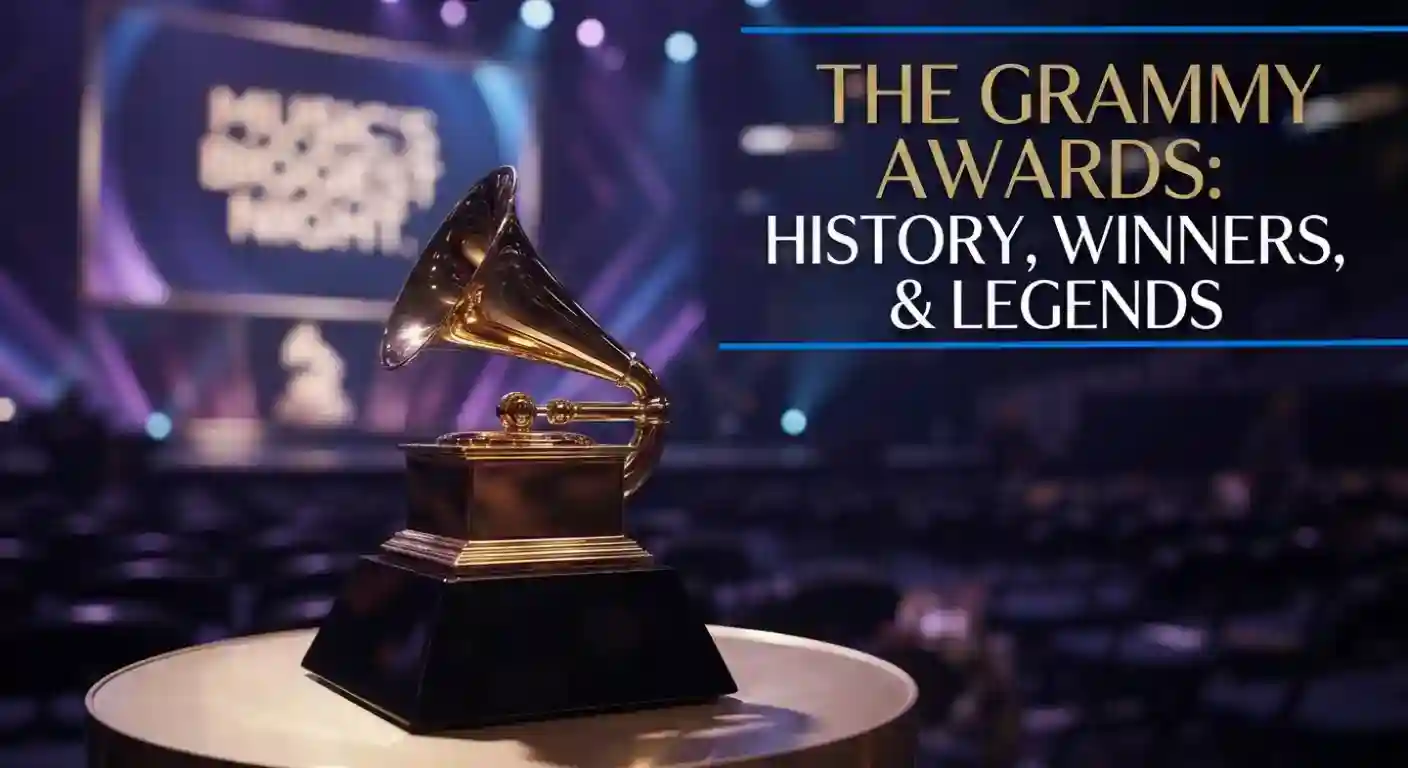
The Grammy Awards : Complete History, Meaning, and Current Status of Music’s Biggest Night
The Grammy Awards: The Complete Story of Music’s Biggest Night
In the American entertainment landscape, few honors carry the cultural weight, career-altering power, and global prestige of the Grammy Award. Often referred to as “Music’s Biggest Night,” the annual ceremony is the music industry’s equivalent of the Oscars for film, the Emmys for television, and the Tonys for theater.
For more than six decades, that gleaming gold-plated gramophone has stood as the ultimate benchmark of artistic excellence in recorded music. Whether you are a casual listener tuning in for blockbuster live performances or a die-hard music fan tracking album-of-the-year races, understanding how the Grammys began, how they became a global television phenomenon, and where they stand today offers a fascinating look into the evolution of modern music.
Table of Contents
What Are the Grammy Awards?
The Grammy Awards—originally conceived as the Gramophone Awards—are annual honors presented by The Recording Academy (officially known as the National Academy of Recording Arts and Sciences, or NARAS) to recognize outstanding achievements in the music industry.
Unlike fan-voted shows such as the American Music Awards or chart-driven ceremonies like the Billboard Music Awards, the Grammys are strictly peer-voted. Winners are chosen by thousands of active music professionals—including recording artists, songwriters, producers, engineers, and instrumentalists—who belong to the Recording Academy. Because the votes come directly from fellow creators rather than commercial sales figures or public polls, winning a Grammy is widely viewed as the highest stamp of artistic validation a musician can receive.
At the center of the ceremony are the “Big Four” General Field categories, which are open to all musical genres:
- Album of the Year: Awarded to the artist, featured artists, songwriters, producers, and engineers behind an entire album.
- Record of the Year: Recognizes the overall performance and production of a single track, honoring the artist, producers, and sound engineers.
- Song of the Year: Honors the craft of songwriting, awarded specifically to the songwriters who composed the lyrics and melody.
- Best New Artist: Celebrates a breakthrough performer whose release during the eligibility period established their public identity.
Beyond the General Field, the Academy presents awards across dozens of genre-specific and craft fields—spanning pop, rock, R&B, rap, country, jazz, classical, Latin, gospel, music video, and audio engineering.
When Did the Grammys Start, and Who Took the Initiative?
The story of the Grammy Awards actually begins on the sidewalks of Los Angeles. In the mid-1950s, the Hollywood Chamber of Commerce launched the Hollywood Walk of Fame project and asked major record label executives to compile a list of recording artists worthy of receiving bronze stars on Hollywood Boulevard.
As this committee worked through the list, they realized a glaring problem: while a handful of marquee singers would receive stars, thousands of brilliant musicians, arrangers, composers, and studio engineers who powered the recording industry would never qualify for a sidewalk plaque. Determined to give the recording business its own prestigious peer-reviewed awards, these executives banded together to form a new organization.
In 1957, this Founder’s Committee officially established the National Academy of Recording Arts and Sciences (NARAS). The key figures who took the initiative included:
- James B. Conkling (former president of Columbia Records, who served as temporary chairman and the Academy’s first president)
- Paul Weston and Axel Stordahl (renowned arrangers and conductors at Columbia Records)
- Jesse Kaye (MGM Records)
- Lloyd Dunn and Richard Jones (Capitol Records)
- Sonny Burke and Milt Gabler (Decca Records)
- Dennis Farnon (RCA Records)
Before settling on a name, the founders briefly considered calling the trophy the “Eddie,” in honor of phonograph inventor Thomas Edison. Instead, they held a nationwide mail-in naming contest. Out of roughly 300 entries, the winning suggestion came from Jay Danna of New Orleans, Louisiana, who proposed “Grammy”—an affectionate nod to Emile Berliner’s invention, the gramophone.
The 1st Annual Grammy Awards took place on May 4, 1959, honoring musical recordings released in 1958. Rather than a single arena spectacle, that inaugural event was held as two simultaneous banquets at the Beverly Hilton Hotel in Beverly Hills and the Park Sheraton Hotel in New York City. Just 28 awards were handed out that night, with Italian singer Domenico Modugno sweeping Record and Song of the Year for “Nel Blu Dipinto Di Blu (Volare)” and Henry Mancini winning Album of the Year for The Music from Peter Gunn.
How Did the Grammy Awards Become So Popular?
In its earliest years, the Grammy ceremony was an industry insider dinner rather than a household television event. Several pivotal shifts transformed it into a cultural juggernaut:
1. The Move to Live Television
While the second Grammy ceremony in late 1959 was taped for broadcast on NBC, the show did not air live until the 13th Annual Grammy Awards in 1971 on ABC. Two years later, in 1973, CBS acquired the broadcast rights—a partnership that lasted for more than half a century. Live television turned the Grammys into real-time appointment viewing for millions of American households.
2. Blockbuster Live Performances and “Grammy Moments”
Unlike the Oscars, where nominees primarily sit in the audience until their category is called, the Grammys evolved into a high-energy, three-and-a-half-hour live concert. Unforgettable television moments cemented the show’s reputation—from Michael Jackson’s historic eight-win sweep in 1984 (which drew a record 51.67 million U.S. viewers) to Whitney Houston’s powerhouse vocal showcases, Prince’s electric appearances, and once-in-a-lifetime cross-genre collaborations like Elton John performing alongside Eminem or Run-DMC teaming up with Aerosmith.
3. Expanding Beyond Traditional Pop and Classical
In the 1950s and 1960s, Grammy voters heavily favored traditional pop crooners, jazz, and classical recordings, often overlooking rock and roll. Over the decades, the Academy steadily added dedicated fields for rock, R&B, country, hip-hop, electronic/dance, and global music. Embracing youth culture and emerging genres kept the ceremony relevant to each new generation of listeners.
4. The “Grammy Bump”
As public prestige grew, winning—or even performing—on the broadcast began translating directly into massive commercial spikes. Historically, Album of the Year winners saw sales surge by hundreds of percent the week after the telecast, proving to record labels that a Grammy campaign was one of the smartest investments in the music business.
Who Made the Grammys a Success?
The sustained success of the Grammy Awards rests on both the visionary executives behind the curtain and the legendary artists who defined the stage:
- Executive Architects: Pierre Cossette, often dubbed the “Father of the Grammy Telecast,” secured the rights to broadcast the ceremony live in 1971 and produced the show for 35 years, shaping its modern entertainment format. Longtime executive producer Ken Ehrlich further elevated the telecast over four decades by championing surprise pairings and tribute medleys. Meanwhile, Academy leaders like Michael Greene, Neil Portnow, and current CEO Harvey Mason Jr. expanded the organization’s global footprint, launched the Latin Recording Academy (and the Latin Grammy Awards in 2000), and established vital industry institutions like the charity MusiCares and the GRAMMY Museum.
- Record-Breaking Artists: Superstars who treated the Grammys as the pinnacle of their craft brought unmatched prestige to the trophy. Beyoncé stands as the most-awarded artist in Grammy history with 35 career wins, surpassing legendary conductor Sir Georg Solti (31 wins). Cultural icons such as Quincy Jones (28 wins), Kendrick Lamar (27 wins, the most by any rapper), Stevie Wonder (25 wins), U2 (22 wins, the most by a group), and Taylor Swift (the first artist to win Album of the Year four times) have kept the awards at the center of pop-culture conversation.
Current Status of the Grammy Awards (2026–2027)
Today, the Grammy Awards remain the undisputed flagship event of the global music calendar, entering an exciting new chapter of modernization and broadcast evolution.
At the 68th Annual Grammy Awards, held on February 1, 2026, at Los Angeles’ Crypto.com Arena and hosted by Trevor Noah, Bad Bunny’s Debí Tirar Más Fotos captured Album of the Year, Kendrick Lamar and SZA won Record of the Year for “Luther,” Billie Eilish took Song of the Year for “Wildflower,” and Olivia Dean was named Best New Artist. That telecast also marked the historic conclusion of CBS’s 53-year run broadcasting the show.
Looking ahead to the 69th Annual Grammy Awards on February 7, 2027, the ceremony is officially moving to ABC, with simultaneous live streaming on Hulu and Disney+ under a landmark 10-year agreement. Under CEO Harvey Mason Jr., the Recording Academy has also enacted major voting reforms—eliminating anonymous nomination review committees in 2021 to increase transparency, diversifying its voting membership of roughly 30,000 professionals, and expanding the slate for the 2027 ceremony to 100 competitive categories, including newly introduced honors such as Best Traditional Country Album and Best Album Cover.
FAQs
1. What does “Grammy” stand for?“
A: Grammy” is short for gramophone, the early disc-playing audio device invented by Emile Berliner. The name was selected via a 1958 mail-in contest.
2. Who actually votes for the Grammy winners?
A: Winners are chosen by the Voting Members of the Recording Academy—working music creators including singers, songwriters, producers, and audio engineers—rather than fans or music critics.
3. What is the difference between Record of the Year and Song of the Year?
A: Record of the Year honors the overall recording, production, and performance of a track (awarded to the artist, producers, and engineers), whereas Song of the Year strictly honors the writing of the lyrics and melody (awarded to the songwriters).
4. Who has won the most Grammy Awards of all time?
A: Beyoncé holds the all-time record with 35 Grammy Awards, followed by classical conductor Sir Georg Solti with 31 wins.
5. Are the Grammy trophies given out on stage real?
A: No. Because every trophy is custom-engraved with the winner’s name after the results are revealed, winners hold reusable “stunt” trophies during the live broadcast and receive their personalized gold-plated Grammium trophies weeks later.
6. How many Grammy categories exist today?
A: The number fluctuates as the Academy updates genres, and for the 69th Annual Grammy Awards (2027), there are 100 categories.
7. Why aren’t all 100 awards shown during the main TV broadcast?
A: To keep the primetime telecast focused on major categories and live performances, roughly 85 to 90 awards are presented earlier the same afternoon during the Grammy Awards Premiere Ceremony, which streams free online.
8. Where are the Grammy Awards usually held?
A: While the show has occasionally visited New York City, Nashville, and Las Vegas, its permanent home since 2000 (with rare exceptions) has been the Crypto.com Arena (formerly Staples Center) in downtown Los Angeles.
9. Where can viewers watch the Grammy Awards in the U.S.?
A: After airing on CBS through 2026, the Grammy Awards air live on ABC and stream on Hulu and Disney+ starting with the February 2027 ceremony.
Disclaimer: This article is provided for general informational and entertainment purposes only. All historical facts, award statistics, and broadcast schedules are accurate as of publication, though Recording Academy rules, categories, and event details remain subject to change.
Follow for captivating articles and stay connected to explore the world. Let’s embrace the power of communication and understanding.

Related topics:
1. Perfect World Travel Guide
2. 9 Most Popular EV Cars in the USA
3. 9 Best Things About Apple TV 4K – Third Generation
4. Think before You Renew Amazon Prime
5. Jimmy Carter: A Great Legacy
6. Memorial Day: Honoring the Sacrifice, Celebrating Freedom
School Site :
For English grammar and lot more : Smart School Infolips
Marathi Poems: Marathi Rang
Technology : Tech Site